
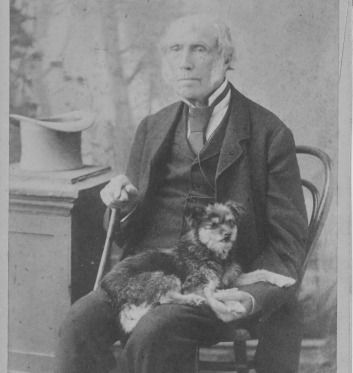
The first land adjacent to the Lithgow Valley to be settled was by Andrew Brown at Bowenfels between 1824 and 1826. Brown had travelled from his home in Methven, Perthshire, Scotland to manage James Walker’s property at Wallerawang. Brown applied for 200 acres of land situated west of the current Lithgow Park to Cooerwull Brook (now Farmers Creek).The property was named Cooerwull after a small blue-bell like flower that grows in the region.
In 1837 Brown established a flour mill at Cooerwull to process wheat grown on his property and from the surrounding district. The mill which was situated on Cooerwull Brook was initially driven by a water wheel and was subsequently converted to steamin 1851. In 1867 the mill was converted to allow for the manufacture of woollen tweeds. The manufacture of tweed at this site continued until 1973.
It is likely that Brown was the first to discover and utilise coal in the Lithgow Valley, with records suggesting that he was cutting coal to run his mill in the early 1860s (Cremin etal 1987, p3)

Brown also built a church and school hall at Cooerwull, now the La Salle Academy. The school, which functioned as an academy for boys was capable of accommodating up to 80 pupils at a time. He was also responsible for building Methven, named after his home town, for his son John Laurence. Methven was completed in 1878 (Cremin etal, p.30). The current Bowenfels Presbyterian Church was also built by Brown as a school hall for children of itinerant railway workers as a gesture of philanthropy.
The City of Greater Lithgow acknowledges and appreciates the History excerpts taken from the Draft Economic Development Strategy for Lithgow which was researched and compiled by Economic and Community Development Class, University of Sydney October 1996